
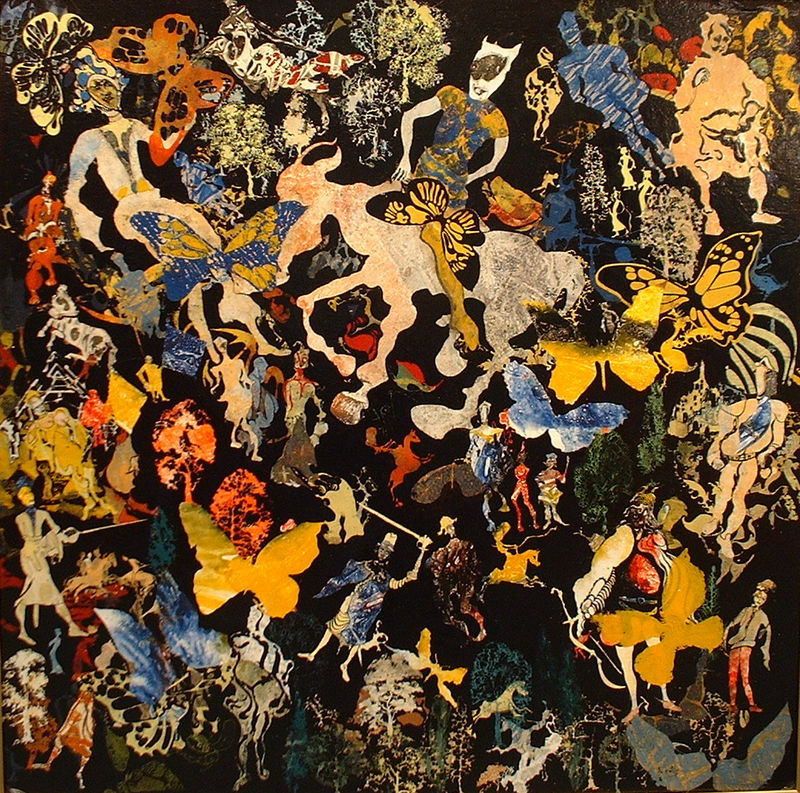
Artist Frank Rosen was born in Bethel, South Africa, in 1918, to Dora and Harry Rosen, Jewish immigrants from the city of Rogachev (now in Belarus). Aged 21, while serving as a commander in the South African Tank Corps during the Second World War, Rosen’s artistic inclinations began to crystalize during his deployments across East Africa, Abyssinia, Egypt, and Italy, and particularly after seeing the Vatican’s art collection, as well as masterpieces by Michelangelo, Raphael, and Leonardo Da Vinci, which he managed to do towards the end of the war. To do towards the end of the war. Between 1955 and 1957, Rosen lived in the UK and studied etching and design at the Central School of Arts and Crafts, London (now Central Saint Martins, UAL). He then briefly returned to South Africa and partnered with Johannesburg-based Dutch engineer, W E Schellorn, to create a new generation, electrically powered etching press. This nearly two-ton press was later shipped to his London studio in the early 1960s. After permanently relocating to London in 1961 with his wife, Selma, and daughter, Lynndy, Rosen shifted his artistic focus from graphic art to oil painting.
Rosen’s artistic practice was characterised by an evolving mixed-media approach, defying easy categorization. While initially producing large-scale abstract expressionist compositions, in line with prevailing European trends, his romantic and literary sensibilities soon led him to embrace elements of fantasy and decorative imagery derived from nature, realised through a mélange of pen drawing, colour etching, oil, aquatint, and later, acrylics. Rosen’s fascination with Chinese and Japanese art, particularly its mastery of line and form, led him to undertake extensive experimentation with Japanese paper to refine his etching technique. This appreciation of delicate form and movement had been nurtured by his frequently attending Royal Ballet performances during their tour of South Africa, culminating in the creation of both his Ballet Series and, later, his single and beloved ‘Omar Khayyam’ painting titled ‘And as the Cock Crew.’ His varied influences ranged from Impressionism and Paul Klee to the Romantic English landscapes of Turner and Constable, Japanese woodblock prints by Katsushika Hokusai, Art Nouveau illustrations of Aubrey Beardsley, and even the technical manuals of Andrew Loomis. This eclecticism further extended to pen draughtsmen of the early 20th century, English watercolours, stained glass, and the architectural forms of Gothic cathedrals. Rosen's oeuvre included a ‘Gothic phase,’ where the influence of illuminated manuscripts, cathedral architecture, and medieval costumes is palpable, often revealing a sense of mystery and the grotesque, reminiscent of 12th-16th century European art and literature. This idiosyncratic synthesis of diverse influences resulted in a body of work rich in both technical innovation and imaginative expression. Rosen’s approach was also influenced by actively studying museum collections around the world.
Rosen exhibited regularly throughout his career. Early recognition came in 1958 and 1959, when his work was included in two consecutive Royal Academy of Arts Exhibitions in London. In this period, the art dealer Albert Duveen also become interested in his art. In 1961, Rosen’s work featured in the São Paulo Biennale in Brazil, marking his growing international profile. In 1962 he exhibited in group shows at the prestigious Redfern Gallery and Leicester Galleries in London. Throughout the 1960s, he demonstrated a philanthropic inclination by donating a series of intricate pen and ink designs for Christmas cards to the South African charity ‘Santa,’ selling over 300,000 cards. His exploration of monochrome aesthetics was evident in his 1966 exhibition of black and white pen and ink drawings at the Pieter Wenning Gallery in Johannesburg. Rosen also experimented with pushing the boundaries of traditional mediums. His pioneering foray into multimedia exhibitions began in the late 1970s, with ‘The Romantic Revival’, a 35-year retrospective spanning his diverse oeuvre. Inaugurated at the California Museum of Science and Industry in Los Angeles, USA in 1979, the exhibition toured various Californian museums throughout the 1980s. Following a suggestion by the museum’s director, William McCann, to explore and create works on an American theme, Rosen inspired by a thrilling helicopter journey over the Grand Canyon responded with a series titled ‘Spirits of the Grand Canyon’ comprising a startlingly colourful and ambitious 28 painting series - acrylic on board, exhibited to wide acclaim at UCLA’s College of Letters and Science Honors Commons in 1986. In 1995, following a creative hiatus after the death of his wife, he created a series of monumental canvases inspired by the ancient fortress of Masada, in Israel, serving as a reflection of history, tragedy and resilience. In addition to his art practice, Rosen was also a Chartered Accountant. Frank Rosen, aged 80, died in London, England in November 1998. In the UK public domain his work is held in the Ben Uri Collection and the collection of Glasgow Museums and adorns the walls of many homes in the UK and beyond.
